My long-term clients are going to laugh at this one.
If you know me well at all, you know I do not buy it when someone says they are just angry. Unfortunately for any anger lovers, I do not believe that a person can only be angry. Emotionally, it is just not possible. Anger is never single; it is always in a relationship.
Let me explain what that means…
Back when I worked with children for the first 10 years of my career, we would address this topic often. Understandably, children do not have much understanding of their feelings other than knowing the basic, surface level emotions. We would use visuals to learn more.
If you are a current or former client, you also know that I use analogies often.
Hey, if they work for kids, why would someone think they would not work for adults? Our brains are not much different after all - topic for another day.

Iceberg: “cold and disconnected” type of anger style.
Notice what you see. It is very strategic. You only see what the iceberg allows as strong enough to be seen. But…you know for a fact there is more under the water.

Volcano: “explosive and aggressive” type of anger style.
Notice what you see. It is very strategic. You only see what the volcano allows as strong enough to be seen. But…you know for a fact there is more under the rock.
Really, no difference here. Same idea, different presentation.
Whether you are hot and reactive, or if you are showing a cold demeanor, there is something else going on deep inside there my friend.
When my clients and I review the feelings wheel, I do not even waste my time on the “anger” category. I know you are angry. I know you are potentially let down, humiliated, bitter, mad, aggressive, frustrated, distant, and/or critical. I read that body language from a mile away. I also know you could feel betrayed, resentful, disrespected, ridiculed, indignant, violated, furious, jealous, provoked, hostile, infuriated, annoyed, withdrawn, numb, skeptical, and/or dismissive. Honestly, those are all very valid. And what do they solve? How far have we gotten in moving past the anger? Probably not far.
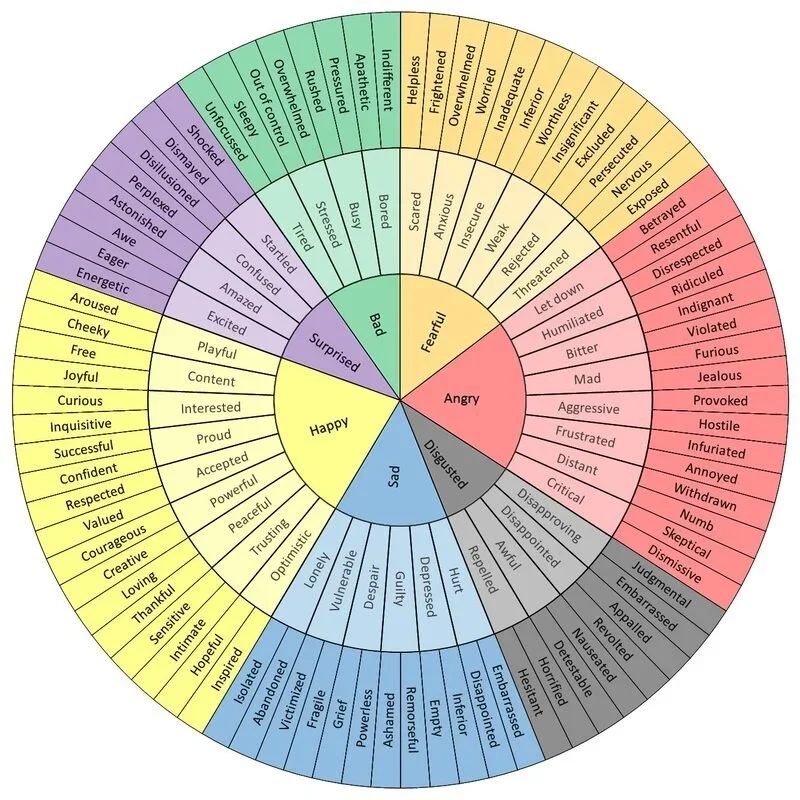
Jump scare to all of my people. Here it is again!
Start in the direct center. Those are our Level 1 emotions. Quite non-descriptive. Pretty basic. Sitting in Level 1 will not get you very far or give you many answers.
Next, move to Level 2: Sad, Happy, Surprised, Bad, Fearful, Angry, Disgusted. In my therapy sessions, we usually zero in on two specific sections of the feelings wheel to dig a bit deeper here: Fearful and/or Sad.
Let’s practice.
Think about the last time your anger was triggered. The situation surrounding the event. Your reactions to the situation.
Now, Level 3: Could there be a slight possibility that you also may have been feeling anxious, insecure, rejected, hurt, vulnerable, or guilty? If the answer is yes to any (or all) of those, that is where we start the processing of emotions. That is where you start getting some answers. That is where the progress can start happening.
-
Example: I am running late for work. I keep getting delayed on my commute. The other drivers are driving terribly. I have to park further away and now I am rushing. I am in a terrible mood: pissed, agitated, crabby.
Alternative feelings perspective that I guide my clients in identifying: I am helpless in my ability to get there faster because the commute is totally out of my control. I hate feeling helpless. I am overwhelmed with feeling rushed and worried that I will get reprimanded or disappoint my team. This will potentially risk how I am viewed to others which may trigger me to feel inadequate. How worthless am I that I cannot even leave the house on time? And now I am nervous that my boss will be pissed off.
Example: My friend ignored my message and now I do not know what time to arrive at dinner. Therefore, I am just not going to go. I hate miscommunication and feel angry that no one cares enough to keep me informed.
Alternative feelings perspective that I guide my clients in identifying: I feel disappointed no one considered letting me know and am embarrassed that I must not be a priority. Now I am going to spend the evening feeling isolated and frankly, I feel abandoned by people that were my friends. Am I not good enough? It makes me feel inferior and that feels horrible. By not communicating with me, I feel excluded from the group.
See what we did here? You could have existed in the anger category all day, if you wanted to. However, now we have identified a grouping of emotions that actually describe what is going on, and we have more to process together. Now the progress can start happening.
Being aware of your own emotions not only builds your confidence within yourself. It will also strengthen relationships and increase your communication skills. Win-win for everyone involved.
Reach out, it is much cooler to be self-aware.